Chapman Holcombe
Point BlankChapman Holcombe, known to the people around Maestro as Chappy, is both a major local power and a repository of practical knowledge about the surrounding caves. As the father of Christie Noble and father-in-law of Sheriff Dixon Noble, he helped establish Dixon’s public career; later, his childhood exploration of the hills offers Dixon’s team a possible way around a rockfall blocking Winkel’s Cave.
Identity, Family, and Public Influence
Dixon Noble describes his election as sheriff as having come through an unusual route. He married Christie Noble, the mayor’s daughter, at twenty-two, when he was newly assigned to Manhattan’s Twenty-seventh Precinct. After five years in New York, the couple decided to return to Maestro. Chapman Holcombe then backed his son-in-law for sheriff. Chapman owned half of Maestro and held numerous other business interests in Virginia, and Dixon says that his backing made the election relatively easy to win. The account connects Dixon’s office not only to his own career but also to the reach of the family into which he married.
Dixon says he had been sheriff for nearly eleven years and had been elected at twenty-six. Those figures sit alongside his recollection of marrying at twenty-two and spending five years in New York before returning; the account does not reconcile the timeline further. Chapman’s support, however, is presented plainly as a decisive local advantage. His influence is also personal rather than merely political: the boys in the family call him Grandpa Chappy, a familiar name that places him within the household as well as among Maestro’s prominent business figures.
Tara and the Holcombe Household
Chapman’s home, Tara, makes his wealth and tastes visible in the landscape. Dixon drives through massive iron gates bearing the name, then follows a graveled road between stone fences, oaks, and maples toward a large white house with Doric columns. Set on a rise and described as resembling a Southern plantation, Tara is presented as an imposing estate rather than an ordinary local residence.
Chapman built the house in the late 1950s for his bride, Angela Hastings Brinkman, of the New Orleans Brinkmans. He had the architect follow descriptions of Tara in Gone With the Wind. The literary model gives the property its name and plantation-like appearance, while the account of its construction ties that display to Chapman’s marriage. The estate thus joins his public stature to a carefully chosen family image: it is a house built for a bride, but also a landmark that announces the standing of its owner.
When Ruth Warnecki is introduced to him at the doorway, Chapman already knows that she is the FBI agent found in Dixon’s woods. He has also heard the town’s talk about Ruth and Dixon and about their Saturday-night truck chase, which he recounts with amused familiarity. His welcome is direct and sociable: he greets the visitors, recognizes Ruth by reputation, and shakes her hand. The scene presents him as a figure accustomed to being informed about local events and comfortable meeting the people at their center.
Knowledge of the Caves
Chapman’s importance to the investigation rests on knowledge formed long before the present search. Dixon tells the group that Christie said her father had explored nearly every cave in the area and that Winkel’s Cave was his favorite; she believed he knew it in extraordinary detail. With the main entrance blocked by a large pile of rock, the searchers cannot simply bring in heavy equipment. Chapman’s familiarity raises the possibility that another entrance, or a connecting cave, could provide a way through.
Asked about alternatives, Chapman recalls an opening near Lone Tree Hill that he found as a boy while looking for arrowheads. He remembers reaching a large cave that seemed to be a dead end, but admits that he may not have inspected it closely. He has not returned in more than forty years. The memory is therefore a lead, not proof that the cave connects to Winkel’s Cave; snow covering the ground also means he will need to show the group where the entrance lies.
Return to the Cave and Its Risks
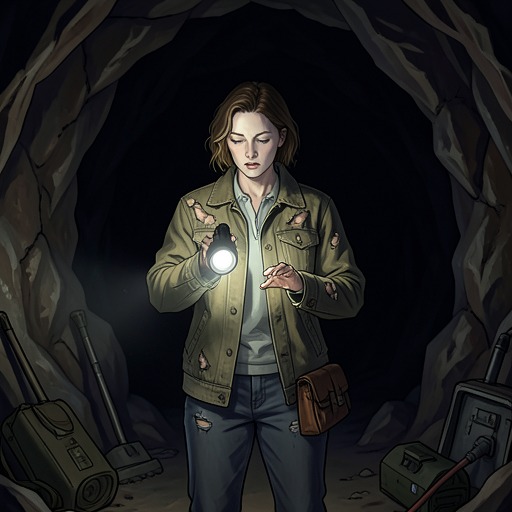
Chapman goes with Dixon, Ruth, and the others to investigate the remembered opening. At the hillside, they remove rocks from an entrance about four feet high and three feet wide. Before anyone proceeds, Chapman elbows his way forward to inspect it, recognizes the descending slope, and takes responsibility for leading. His recollection is specific and cautionary: the passage slopes easily downward on the right, but two feet to the left is a nearly sheer drop.
That warning comes from personal experience. As a teenager, Chapman tried to rappel down the dangerous side. About twenty feet into the descent, bats began swarming upward toward the entrance, and he panicked. He remembers the right-hand passage leading to one large chamber, but cannot remember finding a connection to Winkel’s Cave; he allows only that small connections may exist. He offers to go first and asks the others to follow closely in single file, expecting the passage to widen soon. His experience gives the search party a safer initial route and a concrete sense of the cave’s hazards, while the unresolved possibility of a connection keeps the expedition’s central question open.